
Gardyn Plant Placement Guide: Understanding Light Zones
Overview
Light is one of the most important factors for growing healthy plants on your Gardyn. Where you place your plants directly affects how fast they grow, how much they produce, and how healthy they stay.
Plants are not one-size-fits-all when it comes to light. They have different needs in order to thrive. Luckily, your Gardyn has distinct light zones to provide each plant with its optimal light conditions.
This guide explains how plant placement works on your Gardyn Home or Gardyn Studio, so you can confidently place your plants based on their light needs.
Most plants have an ideal light zone, but many can grow well across a range of conditions. With a few simple guidelines, you can place your plants with confidence and adjust as they grow.
For specific plant placement guidance, refer to the:
At a glance
Plant placement directly affects plant growth, health, and productivity.
Your Gardyn has high, medium, and low light zones.
Fruiting plants need high light to support vigorous growth, flowering, and fruit production
Most leafy greens grow best in medium light.
Most herbs can grow in low to medium light.
Start with the best available placement, then adjust as your plants mature.
If the ideal spot is unavailable, place your plants one light zone lower.
Why Placement Matters
Each plant relies on light to support healthy growth. The right placement helps produce strong leaves and, for some varieties, supports flowering and fruit development.
Too little light leads to slower, weaker growth and lower yield.
Too much light can increase stress for some plants.
Better placement supports stronger, more balanced growth across your Gardyn.
Placing your plants correctly from the start supports healthier growth and better long-term performance.
How Gardyn Light Zones Work
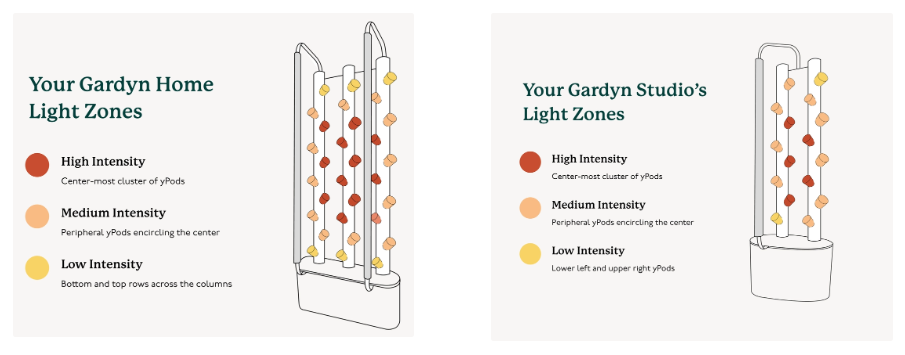
Your Gardyn is designed with different light zones across the system:
High light zones are found in the center of your Gardyn, where plants receive the strongest light.
Medium light zones surround the center, where plants receive moderate light.
Low light zones are found in the outer and lower areas, where plants receive the least light.
These differences in light intensity help support a variety of plant types on the same Gardyn.
Identifying Light Zones on Your Gardyn
Refer to the maps below to find high, medium, and low light zones on your Gardyn Home or Studio.
Plant Placement Guidelines by Plant Type
Once you understand your light zones, use these general guidelines to place most plants on your Gardyn.
Fruiting plants —> High light intensity
Fruiting plants need the strongest light to support healthy leafy growth, flower production, and fruit development.
Examples: Tomatoes, Peppers, Cucumbers, Strawberries, and Eggplant.
Place fruiting plants in the center of your Gardyn, where the light intensity is highest.
Give larger fruiting plants enough space so they do not block light from nearby plants.
Exception: Place cucumbers in the bottom of the middle column so the vine can grow into the higher light as it matures.
Lettuce and Leafy Greens —> Medium light intensity
Lettuce and leafy greens grow best in steady, moderate light conditions that support healthy leaf production without unnecessary stress. In some varieties, too much light can increase stress and contribute to earlier bolting.
Examples: Butterhead, Breen, Salanova and Tatsoi, Kale, and Swiss chard.
Place lettuce and leafy greens in the medium/moderate light zone.
Starting them in the right zone supports healthy, balanced growth and helps reduce unnecessary stress.
Herbs —> Low to medium light
Many herbs grow well in low to medium light because they generally have lower light demands and a slower growth rate. They typically do not need the highest light areas to grow well, and for some herbs, like cilantro, excess light can increase stress.
Examples: Basil, Cilantro, Mint, Parsley, Dill, and Thyme.
Place most herbs in low to medium light areas.
Reserve the highest light areas for plants with greater light demands.
Tips for Better Plant Placement and Growth
Avoid overcrowding
Leave space between larger plants so they do not block light from smaller plants nearby.
Plan for growth, not just setup
Plants will get larger over time, so choose placements that allow them room to expand.
Harvest regularly
Regular harvesting and pruning help manage plant size and improve light access across your Gardyn.
Keep light conditions consistent
Aim for 14 to 16 hours of BOOST light daily to support steady, healthy growth.
Adjust placement as needed
As plants grow, you may need to move them to reduce shading or improve overall balance on your Gardyn.
Find Specific Plant Placement Guidance
Questions? Reach us at support@mygardyn.com, or chat with us. We're here to help!